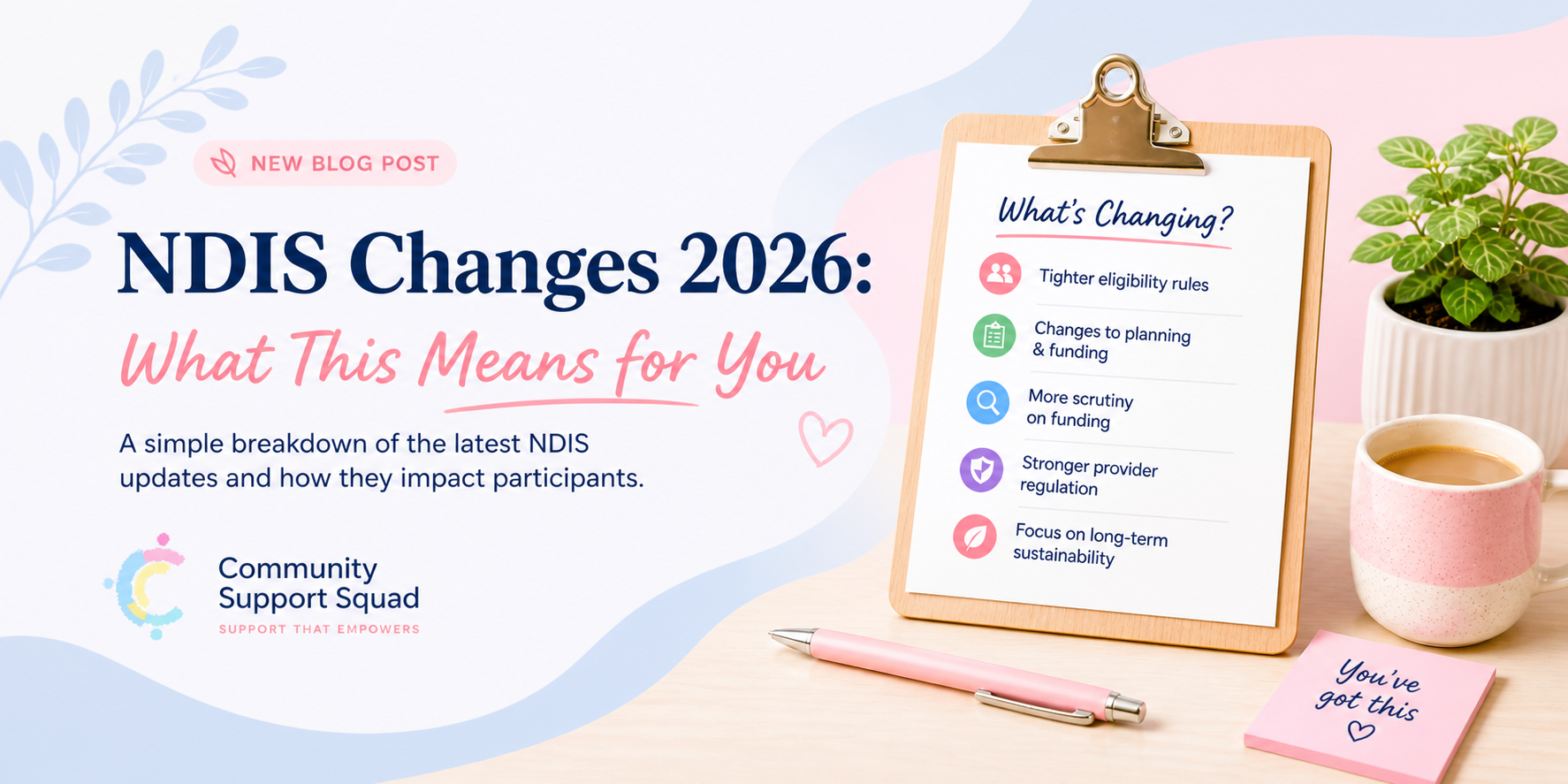
If you have been hearing about NDIS reforms, funding changes, new assessments and different planning rules, you are not alone. There is a lot happening—and not everything being shared online is accurate or happening immediately.
Some changes are already in place, others will begin later in 2026, and the larger changes to NDIS planning are now expected to start gradually from April 2027.
Here is what we know so far and what it may mean for participants, families and carers.
First, take a breath—your current plan has not suddenly disappeared
Most participants can continue using their current NDIS plan and funded supports as usual.
The changes are being introduced in stages. You should be contacted by the NDIA before you personally move into a new planning process.
If you are unsure whether something has changed in your plan, check your most recent plan approval letter or contact your Support Coordinator, Recovery Coach, plan manager or the NDIA.
1. Clearer rules about what NDIS funding can pay for
A new legal definition of an NDIS support was introduced in October 2024. This is supported by lists explaining what is and is not generally considered an NDIS support.
In simple terms, something purchased with NDIS funding should:
- Relate to the participant’s disability support needs
- Assist with their social or economic participation
- Help them pursue their goals
- Represent value for money
- Be effective and beneficial
- Be most appropriately funded by the NDIS—not another service system
Everyday living expenses such as groceries, rent, ordinary household items and general holidays are not usually NDIS supports.
In limited circumstances, a participant may request to use funding for a replacement support. Approval generally needs to be obtained before purchasing it.
Read the current guidance on the NDIS supports lists.
What this means for you
Before purchasing something unusual with your funding, check that it meets the current NDIS rules. Keep written advice, quotes, invoices and evidence showing why it relates to your disability needs.
Your provider or plan manager accepting a claim does not automatically mean the purchase complies with NDIS rules.
2. Funding periods are becoming more common
New and reassessed plans may divide funding into shorter funding periods.
Instead of receiving access to an entire plan budget at once, a portion may become available every month, quarter or another specified period.
Funding periods are intended to help budgets last for the full plan. However, they can make planning supports more complicated—particularly when a participant has irregular expenses or needs intensive assistance at particular times.
Unused funding will generally move into the next funding period within the same plan, but future funding cannot normally be brought forward simply because the current period has been exhausted.
What this means for you
Make sure you understand how much funding is currently available, when the next period begins, whether unused funding carries forward and which services need to be prioritised. Ask your Support Coordinator or plan manager to help prepare a service budget before committing to regular supports.
3. Changes to social and community participation budgets
From 1 October 2026, the government plans to progressively reset budget allocations for assistance with social, economic and community participation and Capacity Building—Improved Daily Living supports.
The government has announced that social and community participation budget allocations will be reduced by 50%, while Improved Daily Living allocations will be reduced by 10%.
This does not necessarily mean every participant’s actual supports or spending will fall by exactly 50% or 10%. The effect will depend on the participant’s assessed needs, current budget, utilisation and plan circumstances.
The government has also stated that participants requiring continuous 24-hour care will continue to receive critical supports and that these changes are not intended to reduce essential daily care.
See the government’s overview of the 2026 NDIS changes.
What this means for you
If you rely heavily on community access, skill development or therapy funding, document what support you receive, how it relates to your disability and goals, what happens when it is unavailable, any associated risks, the outcomes achieved and whether informal supports can realistically help.
4. Stronger record-keeping requirements
Participants, plan managers and providers now have clearer obligations to retain evidence relating to NDIS claims.
Self-managed participants and plan managers will generally need to keep claim records for three years. Records may include invoices, receipts, service agreements and information confirming that the support was delivered.
From 1 December 2026, participants and plan managers will generally need to submit claims within 90 days of the support being delivered.
What this means for you
Keep invoices, receipts, service agreements, quotes, approvals and records of support delivery organised. A simple folder for each provider or month can make this much easier.
5. Unscheduled plan reassessments will have stricter criteria
Only the participant, their plan nominee or guardian can formally request an unscheduled reassessment. A provider or Support Coordinator may help prepare the request, but they cannot make it independently on the participant’s behalf.
A reassessment will generally need to be supported by a significant and ongoing change in the participant’s support needs arising from a change in functional capacity. Participants can still request an urgent plan variation where an emergency or temporary situation requires immediate support.
What this means for you
Evidence should clearly explain what changed, when it changed, whether it will continue, how it affects everyday functioning, why the current plan can no longer meet the person’s needs and what additional disability supports are required.
6. Plans will have clearer end dates
From 1 February 2027, plans will no longer continue indefinitely past their reassessment date in the same way.
When a plan reaches its end date, a renewed plan may be created at the participant’s assessed funding level and adjusted for current prices. Unspent funding from the previous plan will not transfer into the renewed plan.
This does not mean participants should rush to spend funding unnecessarily. NDIS funding must still be used only for appropriate disability-related supports.
What this means for you
Check your plan end date, review remaining funding, book essential assessments early, gather provider progress reports, document unmet needs and avoid committing to services that cannot be funded sustainably.
7. A new way of planning will begin from April 2027
The larger shift to new framework planning has been delayed until 1 April 2027.
The new process is expected to include a support needs assessment—a guided conversation with a trained assessor about the participant’s daily life and disability-related support needs. The assessment will consider the type, amount and frequency of support a person requires.
New framework plans are expected to include:
- A more flexible overall budget
- Some stated supports that can only be used for a particular purpose
- Longer plan periods
- Fewer scheduled reassessments
- Funding based on a support needs assessment and budget method
The transition will happen gradually, beginning with adult participants. Many people will continue under the current planning system for some time. Read the official summary of the legislation changes.
Will diagnosis still matter?
Your diagnosis and medical evidence may remain important, particularly when establishing that an impairment is permanent. However, NDIS decisions are increasingly focused on functional impact—how the impairment affects everyday life and what disability-related assistance is required.
Strong evidence should explain the impact on personal care, communication, mobility, decision-making, learning, emotional regulation, social interaction, household tasks, community participation, safety and the sustainability of informal supports.
Are Support Coordinators being removed?
Support Coordination has not suddenly disappeared from the NDIS. Participants who currently have Support Coordination in their plans can continue using it in accordance with their funding.
There has been discussion about future navigation and coordination models, but changes of that size require formal implementation and transition arrangements. Continue following your current plan unless the NDIA formally advises you otherwise.
What can you do now?
- Read your current plan and approval letter carefully.
- Check whether your plan contains funding periods.
- Monitor spending throughout the plan.
- Keep invoices, receipts, agreements and supporting evidence.
- Ask providers to report on functional outcomes—not just attendance.
- Document unmet needs, risks and gaps in support.
- Start preparing for reassessment well before the plan end date.
- Seek advice before purchasing an unusual support.
- Ask questions if an NDIS decision is unclear.
- Avoid relying on social-media rumours as your only source of information.
Final thoughts
The NDIS is changing, but not every reform will affect every participant in the same way or at the same time.
The most helpful thing you can do is understand your current plan, keep clear evidence and seek support early when your needs change.
At Community Support Squad, we know that NDIS language can feel overwhelming. We help participants and families understand their plans, prepare evidence, coordinate services and navigate changes without losing sight of what matters—the person, their goals and the life they want to build.
Need help understanding your NDIS plan?
Community Support Squad can help you understand your funding, prepare for reassessment and coordinate the supports that matter to you.
Contact our teamThis article provides general information and was updated in September 2026. NDIS rules and implementation dates may continue to change. Please refer to current official guidance or seek advice about your individual circumstances.