Finding the right NDIS support can feel surprisingly complicated.
You might know what you need help with, but not what that support is called under the NDIS. You might have funding sitting in your plan but be unsure what you can actually use it for. Or you may already have providers involved but feel like your support team just isn’t quite working.
And when you start searching for NDIS services in Boronia, suddenly you’re faced with dozens of providers, different services, different rates and a whole lot of NDIS terminology.
So, let’s make it simpler.
If you live in Boronia or Melbourne’s eastern suburbs, here are some of the supports you may come across, what they actually do, and what to look for when choosing the right people for your team.
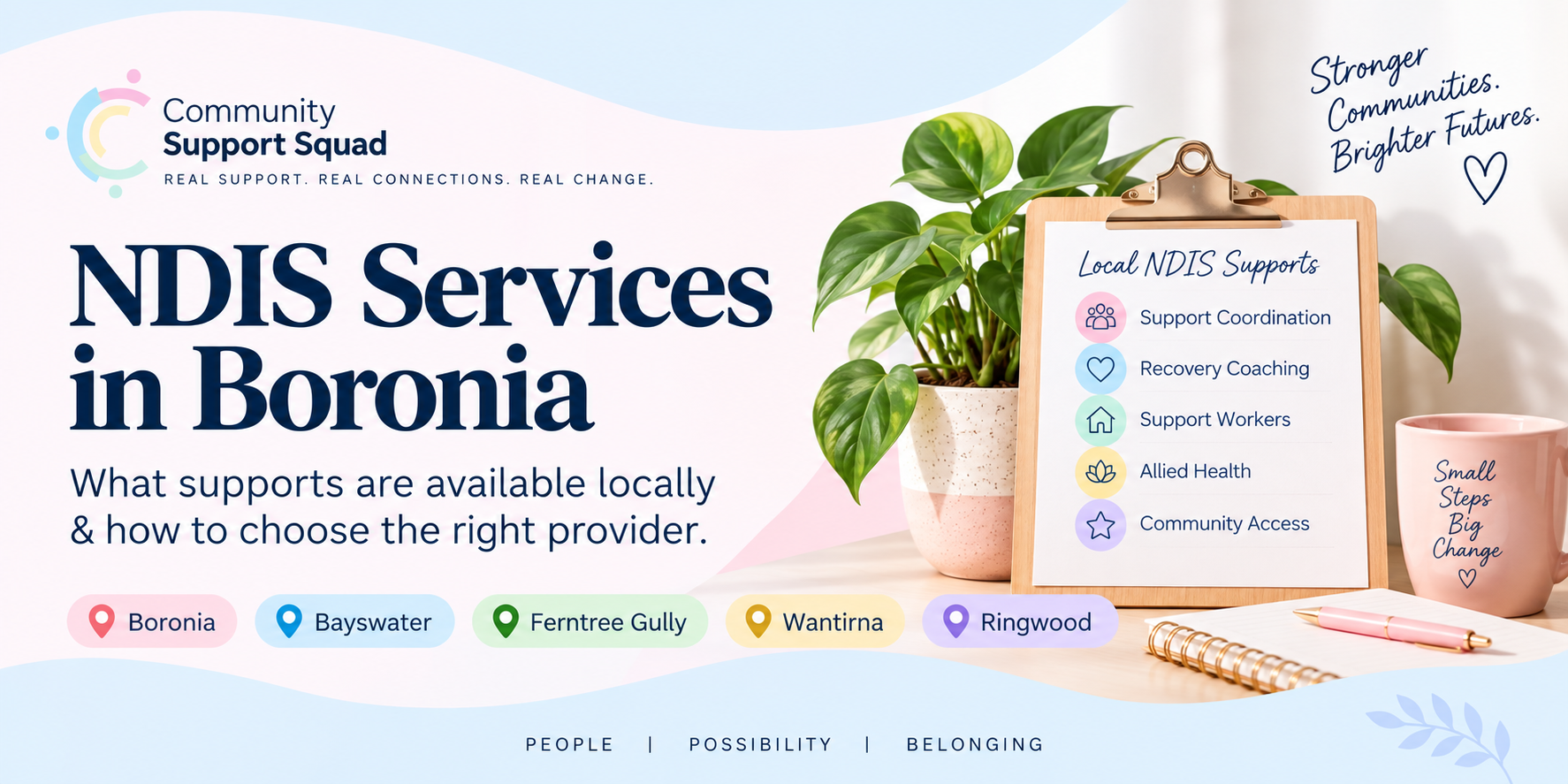
What NDIS Supports Are Available in Boronia?
There isn’t one standard set of supports that every NDIS participant receives.
Your supports should relate to your individual disability-related needs, goals and the funding available within your NDIS plan.
Depending on your plan, you may work with professionals and services such as:
- Support Workers
- Support Coordinators
- Psychosocial Recovery Coaches
- Occupational Therapists
- Psychologists and other mental health professionals
- Speech Pathologists
- Behaviour Support Practitioners
- Physiotherapists
- Plan Managers
- employment and education supports
- community participation services
- assistive technology providers
- home and living supports
You also don’t necessarily need every provider to be based in Boronia.
A good support team might include someone around the corner, another provider elsewhere in Melbourne who travels to you, and a specialist you see by telehealth.
The goal isn’t to collect as many services as possible.
It’s to build a team that actually works for you.
Support Coordination in Boronia
If you have Support Coordination included in your NDIS plan, a Support Coordinator can help you understand your plan and turn the funding on the page into actual supports in your life.
That can include helping you:
- understand your NDIS plan and funding
- identify suitable providers
- establish and coordinate services
- connect with community and mainstream supports
- understand service agreements
- monitor whether supports are actually working
- prepare for changes in circumstances
- navigate problems between services
- build your confidence managing your own supports
- plan for situations where something goes wrong
The NDIS describes three levels of Support Coordination: Support Connection, Support Coordination and Specialist Support Coordination, with the level of assistance differing according to a participant’s circumstances and support needs.
A Support Coordinator is also different from a Plan Manager.
A Plan Manager primarily helps manage the financial administration of plan-managed funding.
A Support Coordinator helps you coordinate the actual supports and services around you.
What should you look for in a Support Coordinator?
Don’t choose a coordinator purely because they’re nearby.
Ask whether they understand the things that are important in your life.
For example, someone with complex psychosocial disability may want a coordinator who understands mental health systems, housing and crisis planning.
Someone interacting with hospitals, Child Protection, Corrections or other government systems may need someone comfortable coordinating across multiple complex systems.
And someone who primarily needs help establishing a straightforward support team may want something entirely different.
A good question to ask is:
“Have you worked with people with needs similar to mine before, and what would your approach be?”
Psychosocial Recovery Coaching
If you live with psychosocial disability, you may have funding for a Psychosocial Recovery Coach.
Recovery Coaching overlaps with some aspects of Support Coordination, but has a specific psychosocial recovery focus.
A Recovery Coach can work alongside you to:
- build capacity and resilience
- understand your supports
- find and organise services
- connect with mental health and mainstream services
- build skills and confidence
- strengthen decision-making
- maintain engagement with supports during difficult periods
- increase independence and community participation
The NDIS also recognises that some people may prefer a Recovery Coach who brings appropriately used lived experience of mental health challenges and recovery.
The relationship matters enormously here.
You should feel listened to rather than managed.
NDIS Support Workers in Boronia
Support work can look completely different from one participant to another.
A Support Worker might assist someone with:
- getting out into the community
- shopping and appointments
- household activities
- building daily living skills
- establishing routines
- attending social activities
- accessing education or employment
- working towards greater independence
- participating in hobbies and interests
For people with psychosocial disability, support work might also involve helping someone gradually reconnect with their community, establish a routine after a difficult period or complete everyday tasks that become overwhelming when their mental health deteriorates.
The important part is that support work should have purpose.
It shouldn’t automatically become somebody doing everything for you when your goal is to develop the ability or confidence to do more yourself.
Allied Health and Therapy Supports
Your NDIS plan may also fund disability-related allied health supports where they meet the relevant NDIS funding requirements.
Around Boronia and Melbourne’s eastern suburbs, participants commonly work with professionals including Occupational Therapists, Speech Pathologists, Physiotherapists, psychologists and Behaviour Support Practitioners.
The right clinician depends on what you’re actually trying to address.
For example, an Occupational Therapist might assess how your disability affects everyday activities and recommend strategies, equipment or environmental changes.
A Speech Pathologist may work on communication or swallowing.
A Behaviour Support Practitioner may be involved where a participant requires specialist positive behaviour support.
This is another area where your Support Coordinator or Recovery Coach can help identify appropriate providers rather than simply sending referrals everywhere.
You Don’t Have to Choose the First Provider You Find
This is important.
You have choice over who provides your supports.
The NDIA specifically recommends researching providers, asking people you trust for recommendations, checking reviews and meeting prospective providers to determine whether they’re suitable.
Depending on how your plan is managed, there can be some restrictions on who you can use. Participants with NDIA-managed funding must use registered providers for those supports, while participants with plan-managed or self-managed funding can generally use registered or unregistered providers, subject to the applicable NDIS rules.
So don’t feel pressured to say yes immediately.
Meet them.
Ask questions.
See how they communicate with you.
And pay attention to how you feel during that first conversation.
Questions to Ask an NDIS Provider Before Signing Up
A provider can have a beautiful website and still be completely wrong for you.
Before agreeing to services, consider asking:
- What experience do you have supporting people with needs like mine?
- Who will actually provide my support?
- Will I have consistent workers?
- How do you match participants with workers?
- What are your hourly rates?
- Do you charge for travel?
- What is your cancellation policy?
- How will you communicate with me?
- What happens if my usual worker is unavailable?
- How do I raise a concern?
- Can I change workers if the match isn’t right?
- What notice do I need to give if I want to leave?
And read the service agreement before signing it.
A service agreement should clearly explain the supports being provided, their cost, how payment works, responsibilities, cancellation arrangements, how problems are handled and how the agreement can be changed or ended. The NDIA also states that participants can suggest changes to a proposed service agreement rather than simply accepting a provider’s standard version.
Local Doesn’t Always Mean Better — But It Can Help
There are definite advantages to having providers who understand the local area.
A worker familiar with Boronia, Bayswater, Ferntree Gully, Wantirna, Knox, Ringwood and the surrounding eastern suburbs may already know the local community centres, health services, transport options, recreation opportunities and mainstream services available nearby.
Travel can also be easier.
But location shouldn’t outweigh quality.
If the perfect therapist for you is 30 minutes away and the provider around the corner isn’t a good fit, proximity alone probably shouldn’t make that decision for you.
Think right fit first, distance second.
What If My Current NDIS Supports Aren’t Working?
You don’t have to remain with a provider simply because you’ve been with them for a long time.
Sometimes a service that worked well two years ago doesn’t suit you anymore.
Sometimes your needs change.
And sometimes a provider just isn’t the right fit.
Depending on your circumstances and service agreement, you may be able to change workers, renegotiate how support is delivered or change providers altogether. Current NDIS guidance specifically recognises changing providers as a normal part of exercising participant choice.
Before changing providers, check your existing service agreement so you understand any notice or cancellation requirements.
If you have a Support Coordinator or Recovery Coach, they can also help you explore alternatives and manage the transition.
Building a Support Team That Actually Works Together
One of the biggest differences between having services and having a support team is communication.
Imagine having a Support Worker, OT, psychologist, GP and Recovery Coach — but nobody knows what anybody else is doing.
Everyone may be trying to help, but the participant ends up acting as the messenger between five different services.
Where appropriate and with your consent, good coordination can help everyone understand their role and work toward the same broader goals.
Your support team shouldn’t feel like five separate islands.
And you should remain at the centre of it.
Finding NDIS Support in Boronia and Melbourne’s Eastern Suburbs
If you’re searching for NDIS support locally, start by working out what problem you’re actually trying to solve.
Rather than:
“I need an NDIS provider.”
Try:
“I need help getting out of the house and reconnecting with my community.”
Or:
“I have funding but don’t understand how to put my plan into action.”
Or:
“I have several services involved and nobody seems to be communicating.”
Or:
“My mental health fluctuates and I need someone who understands psychosocial disability.”
Once you understand the need, finding the right type of support becomes much easier.
The NDIS also maintains a Provider Finder for locating registered providers by suburb or postcode.
How Community Support Squad Can Help
Community Support Squad is based in Boronia, Victoria, and works with NDIS participants across Melbourne’s eastern and south-eastern suburbs.
Our work includes Support Coordination, Psychosocial Recovery Coaching and Support Work, including support for people with more complex circumstances.
We believe good disability support should feel human.
That means taking the time to understand the person behind the plan, communicating clearly, working collaboratively and helping participants exercise genuine choice and control over their supports.
Because the goal isn’t simply to have an NDIS plan.
It’s to build supports around you that actually make a difference in your everyday life.
Looking for NDIS services in Boronia? Learn about Support Coordination, Recovery Coaching, Support Work and how to choose the right local NDIS providers.