🧡 Introduction
If you’ve ever stared at your NDIS plan and thought, “What’s the difference between a Support Coordinator and a Recovery Coach?” — you’re not alone.
These two roles often overlap, but they each play a unique (and important!) part in helping you live your best, most independent life.
Let’s break it down — in plain English.
🧩 What a Support Coordinator Does
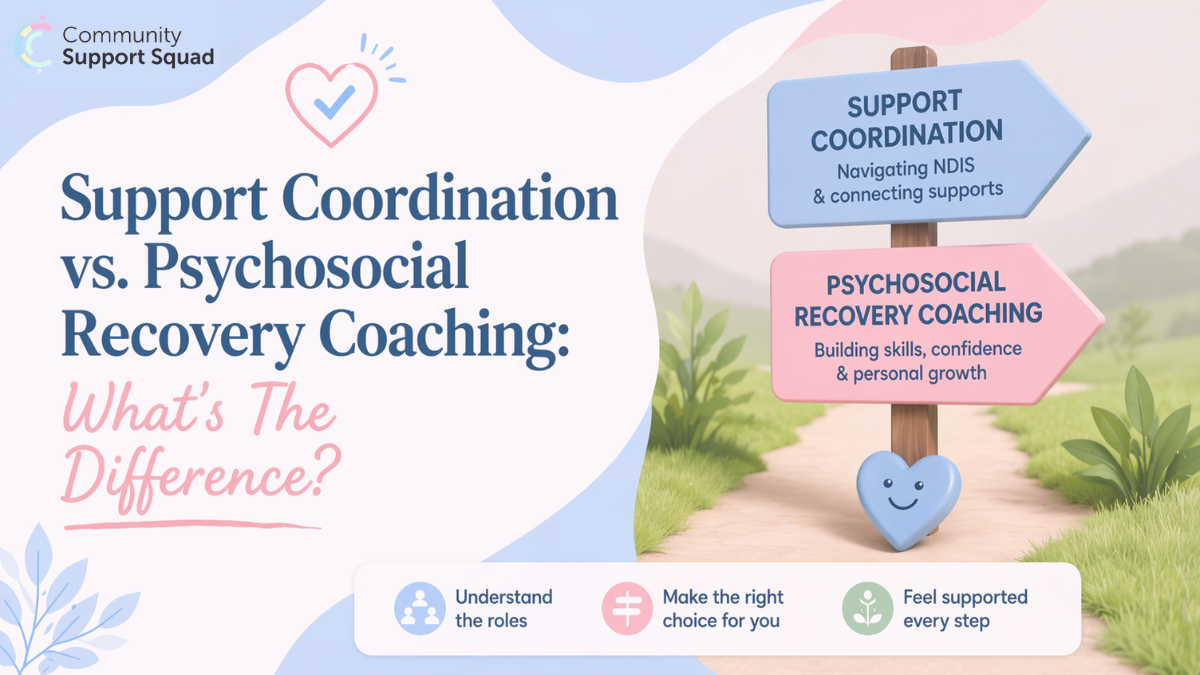
Think of your Support Coordinator as your project manager for life.
They help you understand your plan, find the right providers, and make sure your supports actually work together — not against each other. They bring your supports together to create a collaborating care team that are all there to best support you.
A Support Coordinator helps you to:
- Understand your NDIS goals and funding categories
- Connect with therapists, support workers, and community services
- Solve problems when things go off track (like funding or provider issues)
- Prepare for plan reviews and gather evidence
- Build your confidence to manage things on your own over time
Essentially, they’re your navigator — helping you steer through the sometimes-confusing NDIS system with clarity and confidence.
🌱 What a Psychosocial Recovery Coach Does
A Psychosocial Recovery Coach (PRC) also works under the NDIS, but their focus is on mental health recovery — helping you take back control, one step at a time.
A Recovery Coach helps you to:
- Understand your mental health and how it impacts daily life
- Build motivation, coping strategies, and personal goals
- Coordinate your mental health supports (like psychologists, psychiatrists, and counsellors)
- Strengthen informal supports — friends, family, community connections
- Reconnect with purpose, identity, and self-belief
Recovery Coaches often have lived or professional experience with mental health challenges, which means they get it. They should bring empathy, understanding, and hope into every conversation.
⚖️ The Key Differences
| Support Coordination | Psychosocial Recovery Coaching |
|---|---|
| Focuses on managing and coordinating all supports under your NDIS plan | Focuses more specifically on recovery, empowerment, and mental health goals |
| Works with participants with any disability type | Works with participants with psychosocial disability mostly |
| Helps you understand and use your plan | Helps you regain control, confidence, and daily structure or routine. Also supports you to understand your NDIS plan. |
| Can be short or long-term | Often ongoing and relational |
| Strategic and goal-focused | Reflective and strengths-based |
🤝 When You Might Need Both
Many people benefit from having both roles working together.
For example, someone living with PTSD, depression, or schizophrenia might have:
- A Support Coordinator managing their therapy, housing, and budgeting supports
- A Recovery Coach working on emotional regulation, motivation, and community reconnection
Together, they create a powerful, holistic approach that supports both the practical and the personal side of recovery.
🌈 Real-Life Example: “Finding Balance Through Support Coordination & Recovery Coaching”
When Tara (not her real name) first joined the NDIS, she felt completely overwhelmed. The neverending appointments, paperwork, and confusion about funding left her unsure where to even start.
Her Support Coordinator became her steady hand through the process — helping her make sense of her plan, setting up a clear weekly routine, and connecting her with the right team of supports. Together, they built a strong foundation with an occupational therapist, psychologist, and a small, reliable team of support workers who understood and supported her goals and respected her boundaries.
That structure gave Tara stability — the kind of practical support that turned daily chaos into calm routine.
But the turning point came when she began working with a Psychosocial Recovery Coach. Through gentle, consistent coaching sessions, Tara learned how to rebuild her confidence, identify her strengths, and reconnect with her sense of purpose. She worked on setting boundaries, improving self-care, and discovering new hobbies that brought joy — painting, cooking, and joining a local art class.
“I finally feel like I’m living again — not just surviving,” Tara shared.
The combination of both roles gave Tara the balance she needed — practical stability from Support Coordination, and emotional recovery through coaching.
Now, she describes her life as “calm but full”, and says that having both supports was the key to feeling safe, supported, and independent again.
💫 Why It Matters
Knowing the difference means you can make the most of your NDIS plan.
Each role has its own superpowers, and when they work together, the results can be life-changing, just like the example mentioned above!
💬 At Community Support Squad…
We offer both Support Coordination and Psychosocial Recovery Coaching — delivered by experienced, compassionate professionals who truly care about your journey.
Whether you need help navigating the system, rebuilding your independence, or both — we’re here for you.
👉 Let’s chat about how we can support your goals.
📧 support@communitysupportsquad.com.au | 📞 0448 067 408